
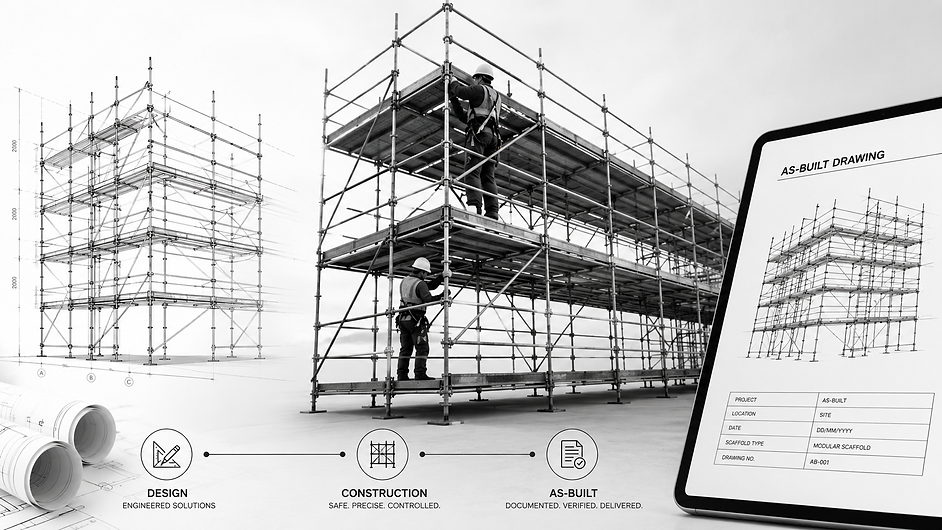
From Design Brief to As-Built: How Scaffolding Actually Gets Built
Most people assume scaffolding is simple. You call a company, they show up, they put up some poles and planks, job done.
On a single-storey house repaint, that's close enough. But the moment a job gets complex — multi-storey, heritage facade, tight site, engineered loads, public access underneath — the gap between a scaffolding contractor who works to a design and one who doesn't becomes the difference between a compliant, safe structure and a liability waiting to happen.
Here's what the full process actually looks like when it's done properly.
It Starts With a Brief, Not a Quote
When a new enquiry comes in, the first thing we're doing isn't pricing. We're reading the job.
What's the structure? What are the access requirements? Is there a builder's programme we need to work around? Are there heritage constraints, council conditions, or engineer's specifications already in play? Is the site live — meaning the public or other trades are moving underneath or alongside the scaffold while it's up?
These questions shape everything that follows. A scaffold designed for a locked construction site looks very different from one designed for a live retail strip with pedestrians walking past daily.
We don't build first and figure it out later. The brief comes first.
Producing the Design
For straightforward jobs, a standard configuration drawing is sufficient — tube and coupler or system scaffold laid out to a recognised standard, with tie patterns, bay sizes, and lift heights documented.
For anything non-standard, we produce a purpose-specific engineered design. This covers:
-
Structural configuration — bay spacing, tube sizes, coupler specifications, bracing layout
-
Tie loads and anchor points — what forces the ties are transferring into the building and whether the facade can take it
-
Ground bearing pressure — what the base plates and sole boards are distributing onto the ground or slab below
-
Live load ratings — what the working platforms are rated to carry, and whether that matches what the trades actually need
-
Special elements — loading bays, overhead protection, hoarding integration, stair towers, cantilever sections
The design gets reviewed, checked, and signed off before a single tube goes on site. If there's an engineer involved — which on complex jobs there usually is — that review loop happens before mobilisation, not after.
This step is where a lot of scaffolding contractors cut corners. Designs get skipped, or a generic drawing gets recycled and applied to a job it wasn't drawn for. On a straightforward residential job, that might not matter. On a six-storey facade over a public footpath, it absolutely does.
When the Design Changes
(And It Always Does)
Here's something no one tells clients: the design you start with is almost never the design you finish with.
Sites change. Builder programmes get revised. The architect adds a window opening. The facade inspection finds spalling that needs access to an area that wasn't in the original brief. The slab turns out to have a penetration where you planned to put a standard.
Design changes mid-job are normal. What matters is how they're handled.
Every variation to the original design gets documented. If a bay gets relocated, a tie point gets moved, or a loading platform gets added, that change goes through the same review process as the original. We don't just adapt on site and hope for the best. The document trail stays current throughout the job.
This matters for two reasons. First, it keeps the structure compliant — a scaffold that drifts from its design without review is a scaffold that may no longer meet the load assumptions it was built to. Second, it matters at the end.
Building to the Design
Erection follows the approved drawings. Our crews work to the configuration documented — bay sizes, lift heights, tie patterns, bracing locations. Not approximately. Exactly.
The reason for this is simple: the design was engineered to specific parameters. Change those parameters on site without review and you've potentially changed the structural behaviour of the structure. A bay that's 200mm longer than drawn isn't a rounding error if it affects the tie spacing or the load distribution.
Supervisors on site have the drawings. Deviations get flagged, not improvised.
As-Builts: The Step Most Contractors Skip
When the scaffold is erected, we produce as-built documentation — a record of the structure as it was actually built, not just as it was designed.
The as-built captures:
-
Final configuration as erected, including any approved design changes
-
Tie locations and types as installed
-
Platform levels and load ratings confirmed
-
Base conditions as constructed
-
Any deviations from the original design and how they were resolved
For most residential jobs, this is a straightforward sign-off. For commercial jobs, strata remediation projects, or any scaffold that's going to be in place for an extended period, the as-built is a critical document. It's what the principal contractor has on file. It's what the engineer can reference if a question arises mid-hire. It's what confirms the structure was built to its approved design.
Clients who've worked with contractors who don't produce as-builts sometimes don't realise they're missing anything — until they need one.
Why This Matters to You
If you're a homeowner getting a roof repainted, the design and as-built process runs quietly in the background and you'll never need to think about it. The scaffold goes up, your painters do their work, the scaffold comes down.
But if you're a builder, project manager, strata manager, or facilities team running a job of any complexity — the documentation trail is part of what you're buying. It's what protects your programme, your compliance position, and your professional exposure if something is ever questioned.
We work with clients who've had bad experiences with contractors who couldn't produce paperwork when it was needed. That's a problem we don't create.
Working With Us
If you have a job coming up — straightforward or complex — the conversation starts with the brief. Tell us the site, the scope, and the timeframe, and we'll tell you what's involved.
📞 1800 072 233
🌐 Request a Quote